
The Claim
"A number of years ago, various trials were conducted through the University of Southampton to help determine if off center installations affect performance. The tests were conclusive: The Hydrovane is absolutely indifferent as to its location – as long as it has 'clean water' to work with, the rudder can produce its certain amount of steering power wherever it is located.
More importantly, however, are the real-life experiences on the water. About 80% of Hydrovane installations in the past 20 years have been mounted off center, and we have hundreds of testimonials from happy customers.
The only advantages of an amidships installation might be the aesthetics (for some traditional boats) and perhaps more protection provided by the boat's keel."
A Matter of Physics and Geometry
This statement is not supported by the available evidence.
Why?
The principles of physics and basic geometry demonstrate that an off-center installation will produce a negative result. The larger the boat, the more pronounced the effect.
The Physics: What Really Happens When the Boat Heels
To calculate the height h relative to the horizontal — that is, how much of the rudder blade rises out of the water when the boat heels — the trigonometric sine function is used:
A concrete example
If you move the windvane 40 cm off the centerline and the boat heels 30°, you will lose 20 cm of rudder blade in the water.
Effective Surface Area: The Real Cost
If 20 cm of the blade comes out of the water, the effective surface area is reduced from the theoretical 30% of the auxiliary rudder blade to 24%.
If we move it 60 cm off the centerline, the result is that we will have lost approximately one third of the original surface area.
| Offset from centerline | Heel angle | Vertical loss (h) | Effective area | Loss vs. centerline |
|---|---|---|---|---|
| 0 cm (centerline) | 30° | 0 cm | 30% | — |
| 20 cm | 30° | 10 cm | 27% | −10% |
| 40 cm | 30° | 20 cm | 24% | −20% |
| 60 cm | 30° | 30 cm | 20% | −33% |
| 80 cm | 30° | 40 cm | 17% | −43% |
Why Total Blade Area Matters
In order to adapt auxiliary rudders to boats of greater length, manufacturers in the industry have had to increase the surface area of their rudder blades. That demonstrates that the total blade area matters.
Therefore, claiming or actively encouraging the installation of an auxiliary rudder off the centerline — regardless of the argument being used, whether it is some supposed university validation or the fact that thousands of users do it — is not consistent with the basic principles of physics and geometry.
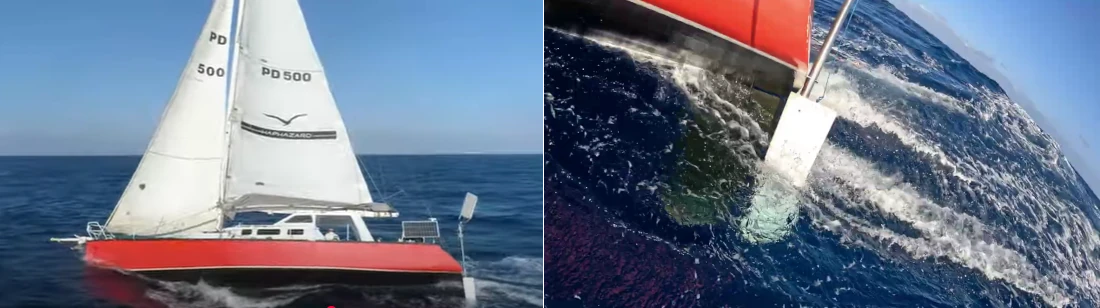
Key point: Physics and basic geometry demonstrate that the result will always be negative. In fact, the larger the boat, the worse the result will be.
Boat Size: Where the Limit Lies
Boats up to ~42 feet
On boats up to, say, 42 feet, you can move the windvane off the centerline — by up to around 30 cm — and partially compensate for the loss of performance by using a larger rudder blade.
This, of course, has a limit determined by the loads that the materials have to withstand.
South Atlantic offers three auxiliary rudder blade sizes precisely to address this reality: giving the installer the ability to recover lost area when a small offset is unavoidable.
Larger boats
But on a larger boat, this is simply no longer a viable solution.
Unless you accept that, with the regular rudder, the system will only work properly when the boat heels toward one of the two sides.
And that, obviously, is not acceptable.
Conclusion
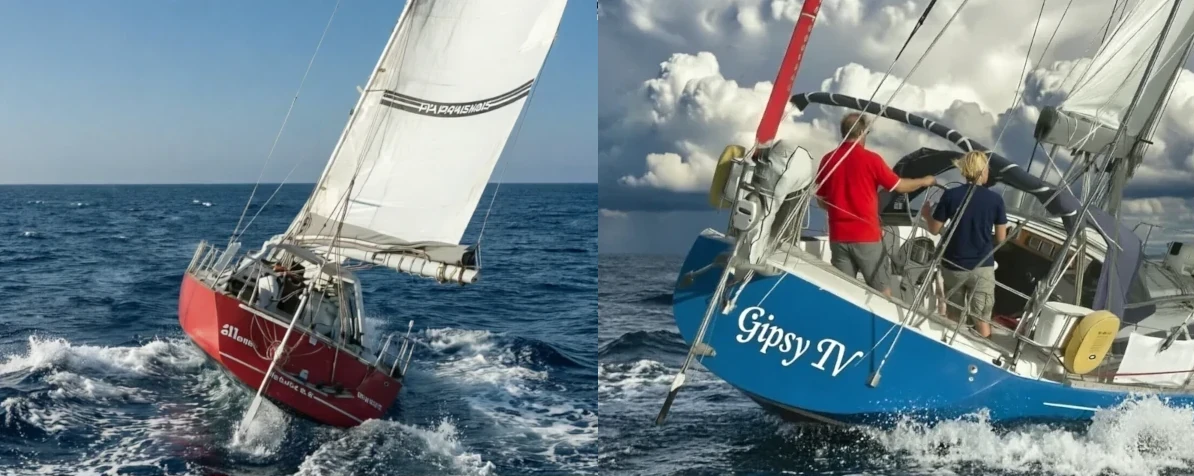
Both the geometry and the images themselves demonstrate this.
An off-center auxiliary rudder installation is not a harmless aesthetic choice. It is a measurable loss of steering power that grows with every centimeter of offset and every degree of heel.
For a system whose entire purpose is to keep your boat on course — day and night, in all conditions — that loss is not something you can afford to ignore.
Install on the centerline. Preserve the full effective area of your auxiliary rudder. Preserve your steering authority when you need it most.
Zasoby techniczne i bibliografia
Dokumentacja techniczna obejmuje następujące pozycje:
-
Politechnika Madrycka (ETSIN), Wydział Architektury Okrętowej.
Zamora-Rodríguez, Izquierdo-Yerón i Botia Vera przeprowadzili eksperymentalne próby w 100 m basenie holowniczym, uzupełnione symulacjami CFD (Computational Fluid Dynamics), w celu zbadania wpływu przechyłu jednostki na hydrodynamiczną wydajność steru. Badanie wykazuje, że siła poprzeczna generowana przez ster zmienia się znacząco w zależności od kąta przechyłu jednostki: rośnie, gdy ster znajduje się po stronie nawietrznej, i maleje, gdy znajduje się po stronie zawietrznej. Wyniki pokazują również, że stopień zanurzenia steru oraz jego orientacja względem napływającego strumienia są decydującymi czynnikami określającymi siłę sterową, jaką może on wygenerować.
-
Uniwersytet Duisburg-Essen (UDE), Niemcy, we współpracy z Federalnym
Instytutem Inżynierii i Badań Dróg Wodnych (BAW) oraz Centrum Rozwoju Technologii Okrętowej
i Systemów Transportowych (DST).
Numericalne i eksperymentalne badanie sił hydrodynamicznych indukowanych przez ster
- Podejście:
- Badania eksperymentalne w basenie holowniczym połączone z symulacjami CFD w celu pomiaru sił poprzecznych, momentów zawiasowych i rozkładów ciśnienia przy dużych kątach natarcia.
- Kluczowy wkład:
- Fundamentalne dla zrozumienia zachowania steru głównego lub pomocniczego, gdy jednostka podlega silnemu odchyleniu od kursu i skrajnym warunkom manewrowym, takim jak broczowanie — sytuacja krytyczna, występująca szczególnie w przypadku lekkich, wysokowydajnych jachtów żaglowych i oceanicznych jednostek żaglowych.
-
Politechnika Duńska (Danmarks Tekniske Universitet – DTU),
Wydział Inżynierii Mechanicznej.
Główny zespół badawczy:
- Stig Staghøj Knudsen — Główny badacz i autor pracy doktorskiej.
- Jens Honoré Walther — Profesor i główny kierownik projektu.
-
Politechnika Duńska (DTU)
Dynamiczna interakcja płyn-struktura (FSI) w łodziach żaglowych regatowych
- Podejście:
- Opracowane na DTU, niniejsze badanie stosuje modele interakcji płyn-struktura uwzględniające elastyczne kadłuby, stępki, stery i foile pracujące w warunkach falowych.
- Kluczowy wkład:
- Demonstruje, w jaki sposób odkształcenie pióra steru w skrajnych warunkach obciążenia zmienia efektywny kąt natarcia i całkowity opór. W wysokowydajnych jachtach żaglowych sztywność skrętna pióra steru pomaga zapobiegać kawitacji i utracie kontroli sterowej (ściągnięciu).
Explore South Atlantic Auxiliary Rudders
Three blade sizes. Centerline-first engineering. Built for bluewater sailors who understand that steering authority is not optional.
Visit the Online Store